Physics
Showing posts with label Physics. Show all posts

Tuesday, January 19, 2016

Physics Unit 2.1: Mass and Weight


Unit 2.1 Mass and Weight

1. Be able to distinguish between the mass and weight of an object.

Mass = the amount of substance in an object; measured in g/kg
Weight = a force due to gravity; measured in Newtons N

2. Demonstrate understanding that mass is a property that ‘resists’ change in motion.

If a force is applied to an object, it does not immediately reach a high speed as it takes time for it to accelerate. If the force is constant, there won't be constant acceleration. If the force is not constant, there will be a moment of acceleration, allowing the object to accelerate. 

For example, you hit a ball. You are the force that moves the ball, and it takes time for the ball to accelerate in the air. If you keep contact with the ball, it stays at a constant speed and will not move faster. If you hit it and lose contact, the ball will fly up into the air and accelerate. 

3. Know that the Earth is the source of a gravitational field. 

Anything with a mass will be pulled down to Earth by the force of weight. If the object has a big mass, a bigger force will be applied to it.

4. Describe, and use the concept of, weight as the effect of a gravitational field on a mass.

In comes the equation for weight:

weight = mass x gravity
N = g x m/s^2


Saturday, December 26, 2015

Physics Unit 1: Motion


Unit 1 Motion

1. Define speed and calculate speed from total distance / total time.

Speed is the rate of how fast something travels, measured by how far it has travelled in how much time. The equation we use to calculate speed is:

speed = distance / time

2. Distinguish between speed and velocity. 

While speed only measures how fast something travels, velocity measures how fast something travels in a given direction. 

3. Plot and interpret a speed/time graph and a distance/time graph.

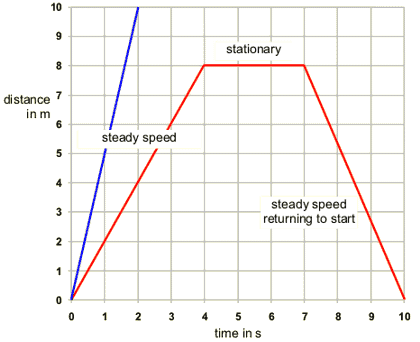
First up is a distance/time graph:


The blue line and first third of the red line represent a steady speed as they go up in straight lines without and changes. The second third of the red line shows that the object is stationary; you can tell because they have not changed their distance but time is passing. The last third of the red line shows the object returning to its start. 

Now a speed/time graph:


The blue line and first third of the red line show constant acceleration. The second third of the red line shows constant speed, as the speed is not changing but time is passing. The last third of the red line shows constant deceleration, because the object's speed is decreasing. 

4. Recognise from the shape of a speed/time graph when a body is 
• at rest, 
• moving with constant speed, 
• moving with changing speed.


5. Recognise linear motion for which the acceleration is constant and calculate the acceleration.

By finding the gradient of the line, we can find out if the acceleration is constant. The equation for this is:

acceleration  = change in velocity / time taken

To figure out the change in velocity, you deduct the initial velocity from the final velocity. 

6. Recognise motion for which the acceleration is not constant.

When this is plotted out onto a graph, the line will not be consistent, representing non-constant acceleration.


7. Calculate the area under a speed/time graph to work out the distance travelled for motion with constant acceleration. 

To do so, we need to find the gradient of the graph using the rise and the run. The rise is how much the steep rises from its starting position, and the run is how far it travels horizontally from its starting position. 


For example, we take random x,y points from the graph above: 4, 20. To find the area, we calculate the area of a triangle, as the shape of the rise/run form a triangle: (4 seconds x 20 meters/second) / 2 = 40 meters. 

8. Demonstrate a qualitative understanding that acceleration is related to changing speed. 

Acceleration is the rate of which an object changes speed, so when a speed changes, we assume that the acceleration has either increased or decreased. 


Physics Unit 4: Simple Kinetic Molecular Model of Matter


Unit 4.1 States of Matter

1. State the distinguishing properties of solids, liquids and gases.

Solid Liquid Gas
Particles are tightly packed in a regular pattern Particles are loosely bonded with gaps between them Particles are completely seperated
Particles vibrate together, keeping its shape and position Particles vibrate and slide past one another Particles are free to move
Retains a fixed volume and shape Takes shape of its container Takes shape of its container
Does not flow easily Flows easily Flows easily

source


Unit 4.2 Molecular Model

1. Describe qualitatively the molecular structure of solids, liquids and gases. 


As mentioned above, particles in solids are in fixed positions, while particles in liquids and gases are more free.

2. Relate the properties of solids, liquids and gases to the forces and distances between molecules and to the motion of the molecules.

In solids, the particles are close together because they are bonded in fixed positions. In liquids, the particles are attached together but are not as rigorously held together as particles in a solid. In gases, the molecules are completely unattached so the space between particles can be far and wide. 

3. Interpret the temperature of a gas in terms of the motion of its molecules.

When a gas is hot, its particles move quickly and collide often. This is because heat energy is given to the particles, giving them the kinetic energy to move. The hotter the gas, the faster the particles will move. 

4. Describe qualitatively the pressure of a gas in terms of the motion of its molecules.

Imagine you've got a sealed container containing gas. When the gas particles move, they hit the sides of the container; this creates pressure on the container. The pressure of the gas depends on how often and how hard the molecules are colliding with the inside of the container. 

5. Describe qualitatively the effect of a change of temperature on the pressure of a gas at constant volume.

You know that a high temperature = faster motion and faster motion = more pressure. Therefore, the higher the temperature of gas, the more pressure of the gas at constant volume. 


Unit 4.3 Evaporation

1. Describe evaporation in terms of the escape of more energetic molecules from the surface of a liquid.

Evaporation occurs when there are particles in a liquid that move faster, so fast that if they are near the surface they have enough energy to escape and become a gas. 


2. Demonstrate understanding of how temperature, surface area and air flow over a surface influence evaporation.

Temperature: a higher temperatures means that the particles have more energy to escape, resulting in  a faster rate of evaporation.
Surface area: with a bigger surface area, more of the molecules are at the surface, allowing them to escape.
Air flow: air flow picks up molecules at the surface before they can become liquid again. The higher rate of air flow, the faster the evaporation. 

3. Relate evaporation to the consequent cooling.

When water evaporates, it takes some thermal energy from whatever is has been on, resulting in that thing being cooler. Faster particles escape first, so slower particles are left behind; this means the temperature is lower than before. 


Unit 4.4 Pressure Changes

1. Relate the change in volume of a gas to change in pressure applied to the gas at constant temperature and use the equation pV = constant at constant temperature.

Boyle's law states that pressure and volume are inversely proportionate when the gas is at a constant temperature. Lowering the volume will increase in a higher pressure, and vice versa. This is because if a gas has a smaller volume, there is less space for the particles to move; they hit the sides of the container more frequently, resulting in higher pressure. 


Tuesday, December 22, 2015

Physics Unit 15.5+6+7: Safety Precautions, The Nuclear Atom, Isotopes


Unit 15.5: Safety Precautions

1. Describe the hazards of ionising radiation to living things.

All types of radiation (alpha, beta, and gamma) can damage living cells because they can ionise. Ionising radiation breaks down molecules into ions. Chemical reactions in living cells can be affected by these ions. This can cause living cells to die, or mutate and become cancerous.


2. Describe how radioactive materials are handled, used, and stored in a safe way to minimise the effects of these hazards. 

You should stay away from radioactive materials, avoiding the eyes. If possible, you should be protected from them, and use appropriate equipment to handle them. For example, tongs.
Radioactive materials are stored in containers lined with lead to make sure that it is not exposed to the environment outside.
Film badges can detect radiation; they will turn black to measure the amount of radiation a person is exposed to. The badges should be checked regularly to make sure the person is not experiencing too much radioactivity.
Wear goggles while dealing with radioactive materials, and wash hands after using them.
Limit the amount of time exposed to radiation.
Look out for the radioactive hazard symbol.


Unit 15.6: The Nuclear Atom


1. Describe the composition of the nucleus in terms of protons and neutrons.

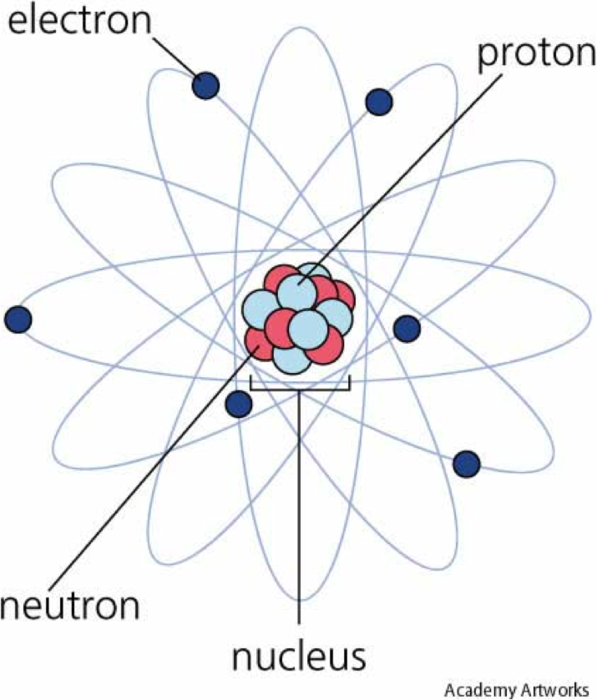
In an atoms nucleus, you have protons and neutrons. Electrons are located on the outside of the nucleus.


2. Use the term proton number Z.

The proton number is the number of protons you have in an atom. For example, let's take a look at oxygen.


As seen from the diagram above, oxygen has 8 protons; the proton number can also be called the atomic number.

3. Use the term nucleon number A.

The nucleon number is the number of protons and neutrons combined. Using the diagram from above, we see that since oxygen has the proton number of 8 and the nucleon number of 16, it means that in oxygen there are 8 neutrons. The neutron number is also called the atomic mass.


Unit 15.7: Isotopes


1. Use the term isotope.

Some elements have more neutrons than others and they have various versions. These versions are called isotopes. The chemical properties are the same, but they have different masses due to the different amounts of neutrons. The number of protons, however, are the same, as a different number of protons would make it a different element.

2. Give and explain some practical uses of isotopes.

Take chlorine for an example. Its atomic mass is 37.5, because they have put the mean of the isotopes onto the Periodic Table. Isotopes are uses in medical therapy. For example, Cobalt 60 (as in 60 neutrons) is used to treat cancer and sterilise equipment.

3. Use the term nuclide and use the nuclide notation.

A nuclide is an atom or nucleus characterised by its number of protons and neutrons.


Above is a diagram explaining nuclide notation. Nuclide notation is what you would see on the Periodic Table.


Thursday, November 19, 2015

Physics Unit 14.2+3: A.C. Generator, Transformer


Unit 14.2: A.C. Generator

1. Describe a rotating-coil generator and the use of slip rings

A little terminology to learn first:
A.C. = alternating current. This means instead of the current flowing in one direction, it flows back and forth.

Here's an example of an A.C. generator


Between the magnet is a magnetic field. The wire loop is made of insulated copper wire and is turned. As it turns, it cuts those magnetic field lines, inducing current and generating electricity that can power a bulb if it is attached to the generator. 

The slip-rings are connected to the coil of wire, while the carbon brushes are connected to an external circuit. The brushes are constantly in contact with the slip-rings so that the current can flow from the coil to the external circuit. 

You can see that the magnetic field lines run horizontally. If the coil is also laid horizontally, it lays in line with the field lines and don't cut them, so no current is induced. When the coil is rotated, it begins to cut the field lines at angles. At 45 degrees, a small current produced; at 90 degrees, a larger current is produced. 


2. Sketch a graph of voltage output against time for a simple a.c. generator.


This diagram further elaborates on the 45° and 90° explanation from above.


Unit 14.3: The Magnetic Effects of a Current

1. Describe the construction of a basic iron-cored transformer as used for voltage transformations.

A transformer is an electrical device that changes the voltage of an A.C. current supply. For some devices, only a small voltage is needed to charge it. A transformer helps decrease the high voltage from the electrical source so when charged, the device will not break. This transformer is called a step-down transformer as it is stepping down the voltage. This can be reversed and we will have a step-up transformer.


An electric current is passed through the primary coil of wire. The magnetic field from the primary wire grows, collapses, turns (because it's an a.c. current), grows, collapses; those field lines cut the secondary wires, inducing electricity. The diagram above shows a step-down transformer as the secondary wire has less coils. Therefore, the output voltage will be smaller. The more coils present, the stronger the current will be. 


2. Recall and use the equation (VP / VS) = (NP / NS). 

V stands for the voltage while N stands for the number of turns. The voltage and number of turns are proportional, so the factor affecting one side of the equation will also affect the other. Below is an example:


3. Describe the use of the transformer in high-voltage transmission of electricity.

The National Grid is the nation's power supply. It transfers electricity from the Grid to homes for use. When a current is passed through those the wires of the Grid, heat is lost. Since it needs to supply electricity for many different places, a high current is needed; however this results in a lot of energy being lost as thermal energy. Instead, the Grid transmits electricity at a low current to reduce heat loss. A high voltage is required in order for this to work. Since a high voltage is dangerous to use in homes, transformers are used to step down this power supply, making it safe to use.


4. Recall and use the equation Vp / Ip = Vs / Is (for 100% efficiency).

We know that voltage divided by current gives power, so this equation tells us the primary power is the same as the secondary power. With this equation you can determine how much power goes through one end of the transformer and how much goes out, since it is assumed that the transformer is 100% efficient and does not waste any energy.


5. Explain why energy losses in cables are lower when the voltage is high. 

As said above, energy is lost as heat when a current is run through a wire. From the power equation we know that voltage and current are proportional to make the final power product. If the voltage is high, this means the current is low, resulting in less power loss. 


Physics Unit 3.2: Energy Resources


Unit 3.2: Energy Resources

1. Distinguish between renewable and non-renewable sources of energy.

Renewable sources of energy are sources of energy that can replenish itself, will not run out, and does not harm the environment. Examples are solar energy and wind energy. Non-renewable sources of energy are sources of energy that are used up once used, and cannot be replaced. Examples include coal and oil.


2. Demonstrate understanding that energy is released by nuclear fusion in the Sun.

Because of nuclear fusion reactions within the Sun, it radiates energy. A small fraction of this energy reaches the Earth.


3. Know that the Sun is the source of energy for all our energy resources except geothermal and nuclear. 

The Sun's energy can be used for solar panels and cells. It also in the food we eat, wood that we burn, biofuels from waste, plants, and fossil fuels. The Sun's energy has helped shape the end product that we come in contact with. 

Geothermal energy is due to the heat from the deep, hot layers within the Earth. Nuclear energy comes from a process called fission, which is the process of splitting uranium atoms. The energy released form fission produces steam that can turn a turbine, similar to how the steam from heating water with fossil fuels can turn a turbine.


4. Describe how electricity or other useful forms of energy may be obtained from; 
● chemical energy stored in fuel,
● water, including the energy stored in waves, in tides, and in water behind hydroelectric dams,
● geothermal resources,
● nuclear fission,
● heat and light from the Sun (solar cells and panels)
● wind.

Chemical energy can be obtained from burning fuel. When the fuel (oil, coal, wood, waste biofuels) is burnt, it releases heat energy, resulting in an exothermic reaction.

We can also obtain energy from the movement of water. Water is moved by wind, tidal energy, or being held back in a dam and then released; the movement turns generators in the water that create energy.

As mentioned above, geothermal energy comes from hot rocks deep underground. The thermal energy released heats water, which creates steam that can drive generators or heat buildings. Nuclear energy is a reaction due to fission, and this also heats up water to create steam.

Solar cells and panels suck up heat energy directly from the Sun, as they must be in contact with the Sun in order to work.

Wind energy is using the wind's movement to push turbines and turn generators.


5. Give advantages and disadvantages of each method in terms of reliability, scale, and environmental impact.

Energy source
Advantages
Disadvantages
Fuel - ready-made
- cheap
- unenvironmentally friendly
- creates greenhouse gases
Wave - renewable
- does not produce greenhouse gases
- source may not always be present
Tidal - renewable
- does not produce greenhouse gases
- source may not always be present
Hydroelectic - renewable
- does not produce greenhouse gases
- hydroelectric plants affect life in the water
- expensive to develop usage sites
Geothermal - renewable
- does not produce greenhouse gases
- effectiveness varies on the location
- expensive to develop usage sites
Nuclear - a small amount of radioactive material produces
lots of energy
- relatively cheap
- no atmosphere pollutants
- creates nuclear waste
- leakage of nuclear waste is very serious
Heat - renewable
- does not produce greenhouse gases
- source may not always be present
- expensive to make solar panels
Light - renewable
- does not produce greenhouse gases
- source may not always be present
Wind - renewable
- does not produce greenhouse gases
- a lot of land is needed to build wind turbines
- noisy
- visual pollutant
- energy can't be produced in large quantities
- source may not always be present


6. Recall and use the equation: efficiency = energy input/useful energy output x 100%

Efficiency = energy input/useful energy output x 100%


7. Demonstrate a qualitative understanding of efficiency. 

For example, if 100J of energy goes into a lamp and 75J of light energy comes out, the efficiency of the lamp is 75%.

Tuesday, November 17, 2015

Physics Unit 11: Magnetism


Unit 11: Magnetism

1. Describe the properties of magnets.
● opposite poles attract; same poles repel
● field lines travel from N to S
● produces a magnetic field which can then produce a current
● a temporary magnet that loses its magnetism easily is known as a soft magnet
● a permanent magnet that does not lose its magnetism easily is known as a hard magnet


2. Give an account of induced magnetism.

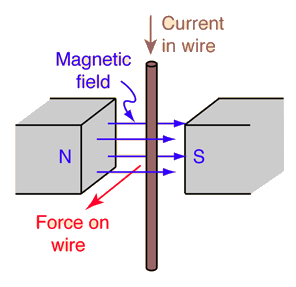
When you rub a wire between a N and S pole, the wire cuts the horizontal magnetic fields at a 90° angle. This induces a current. 


The same thing occurs with a solenoid (a coil of wire) and a magnet. The magnet is moved inside the solenoid, creating a current. 


The speed of the magnet within the solenoid and the amount of coils of the solenoid both affect the current induced. Faster movement and more coils induce a greater current. 


3. Identify the pattern of field lines round a bar magnet.


This diagram basically sums up this point on the syllabus. 


4. Distinguish between the magnetic properties of iron and steel.


Iron Steel
Is a soft magnet Is a hard magnet
Useful for making temporary electromagnets; strong but temporary Slow to magnetise but retains its magnetism
High susceptibility, low retentivity Low susceptibility, high retentivity


5. Distinguish between the design and use of permanent magnets and electromagnets.

Permanent magnets
● magnetism is permanent
● its atoms are aligned to produce a constant magnetic field
● used for compasses, fridge magnets, and cabinet doors

Electromagnets
● magnetism works only when a current is induced
● used for transformers, motors, and loudspeakers


© Look Good & Study Hard
Maira Gall